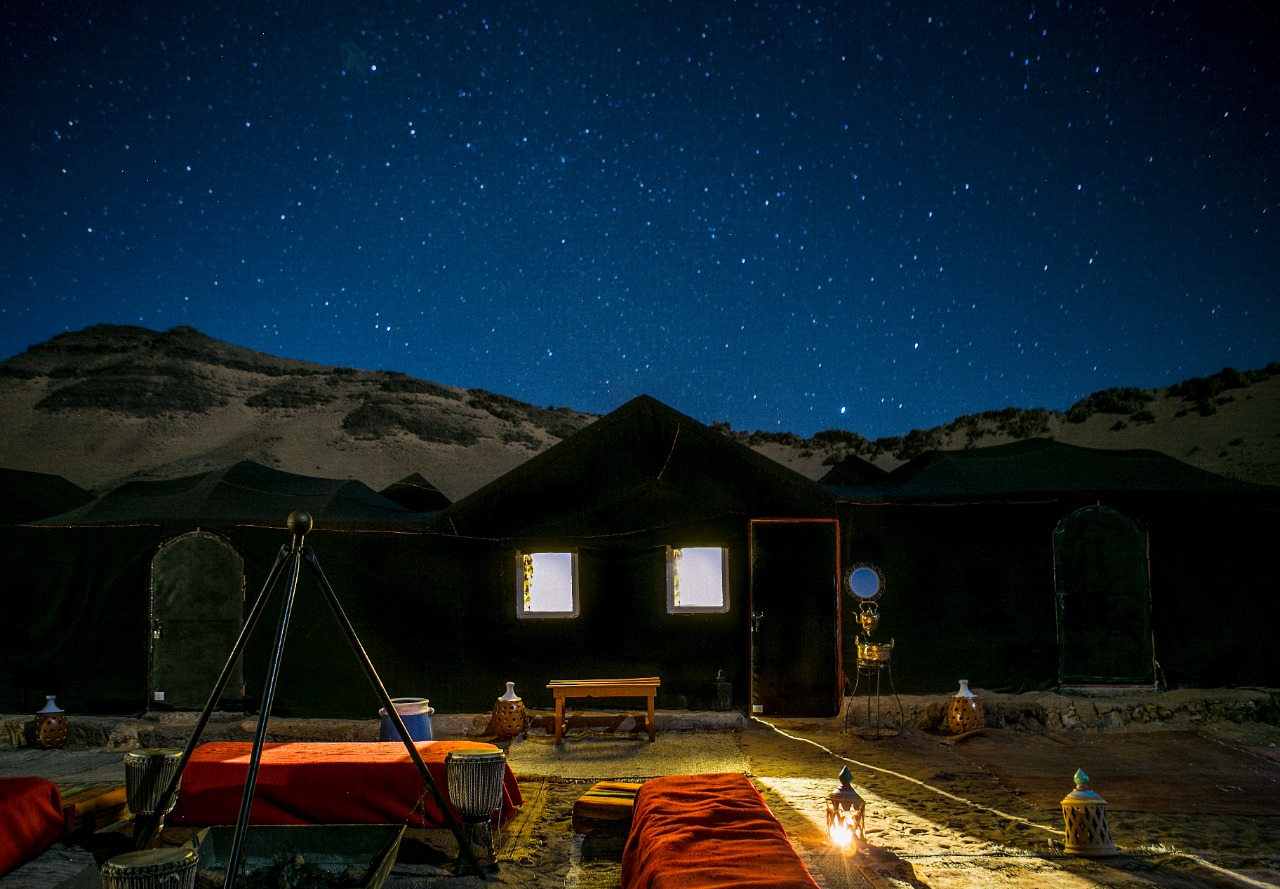
Ask travellers what they remember most about a night in the Moroccan Sahara and many will not mention the dunes at all. They will talk about lying on cool sand after dinner, the campfire dying down, and looking up at more stars than they have ever seen. The desert is one of the best places in North Africa to experience a truly dark sky — if you time your trip well.
This guide explains how to plan Sahara stargazing in Morocco: where the skies are darkest, how the moon changes everything, what you can see in each season, and how to photograph the Milky Way from a desert camp.
Why is the Sahara so good for stargazing?
Three things make the Moroccan Sahara exceptional for observing the night sky:
- Very low light pollution. Desert camps in Erg Chebbi and Erg Chigaga are far from large towns, and dunes block much of the remaining glow on the horizon.
- Dry, clear air. Low humidity and few clouds for much of the year mean sharp, steady stars.
- Wide, unobstructed horizons. From a dune crest you see the sky right down to the horizon in every direction.
The result is a sky where the Milky Way is clearly visible to the naked eye on moonless nights, along with thousands of stars, planets and the occasional meteor. If you have only ever seen the sky from a European or North American city, the difference is striking.

Where is the best stargazing in the Moroccan Sahara?
| Location | Darkness | Access | Best for |
|---|---|---|---|
| Erg Chigaga | Excellent — no village nearby | 4x4 from M'hamid | The darkest skies and solitude |
| Erg Chebbi (camps deep in the dunes) | Very good | Camel or 4x4 from Merzouga | Combining big dunes and stars |
| Erg Chebbi (camps at the dune edge) | Good, some village glow | Easy | Convenience |
| Zagora | Good | 2 days from Marrakech | Short trips |
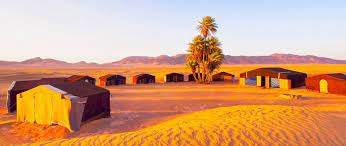
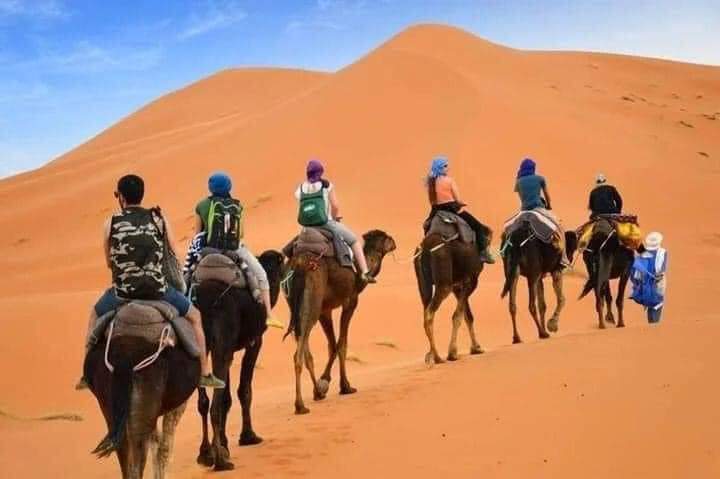
Within Erg Chebbi, camps located a 45–90 minute camel ride into the erg generally have darker skies than those near the paved road and hotels. If stargazing is a priority, ask about the camp's location when you book our 3-day Marrakech to Merzouga desert tour or the 3-day Fes to Merzouga tour. For the very darkest sky, the 2-day Erg Chigaga tour from Ouarzazate is hard to beat — see also our Erg Chigaga guide.
How does the moon affect Sahara stargazing?
The single most important factor is the moon phase. A full moon in the desert is beautiful — bright enough to walk the dunes without a torch — but it washes out the Milky Way and faint stars. For the best stargazing:
- Travel within about 5 days either side of the new moon.
- Around first quarter, the moon sets in the evening, leaving the second half of the night dark.
- Around last quarter, the evening is dark and the moon rises after midnight.
Check a moon calendar before choosing dates. If your dates are fixed around a full moon, enjoy the moonlit dunes instead — it is a different but equally memorable experience.
What can you see in the Sahara night sky by season?
| Season | Highlights | Night temperature (approx.) |
|---|---|---|
| Spring (Mar–May) | Milky Way core rising before dawn later in the season; Leo, Virgo | Cool to mild |
| Summer (Jun–Aug) | Milky Way core high in the evening; Scorpius, Sagittarius; Perseid meteors in mid-August | Warm |
| Autumn (Sep–Nov) | Milky Way setting in the west in early evening; Pegasus, Andromeda Galaxy visible | Mild to cool |
| Winter (Dec–Feb) | Orion, the Pleiades, Sirius; Geminid meteors in mid-December | Cold, near freezing |
The brightest part of the Milky Way — the galactic core toward Sagittarius — is best seen from roughly April to September. Winter skies lack the core but are wonderfully crisp, with Orion dominating the south. For background on the galaxy itself, the Milky Way article on Wikipedia is a clear introduction.
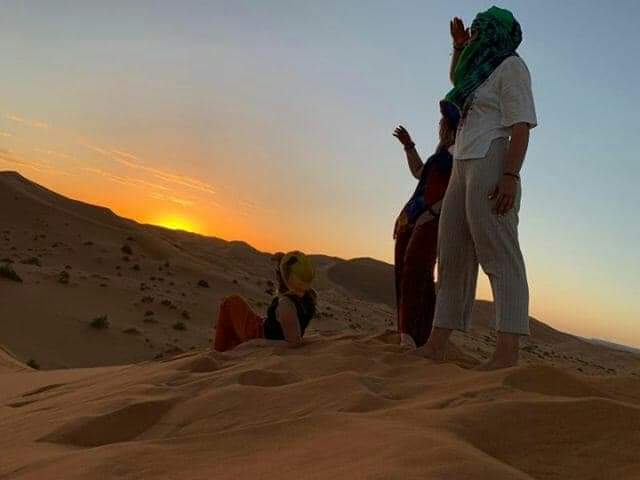
How to stargaze from a desert camp: step by step
- Pick your dates near the new moon and check the forecast for clear skies.
- After dinner, walk away from the camp lights — 5 to 10 minutes onto a nearby dune is usually enough. Take a headlamp with a red-light mode.
- Let your eyes adapt for 20–30 minutes without looking at your phone screen.
- Lie down on a blanket or sit on the dune crest facing south.
- Use a star app in night mode to identify constellations and planets, then put the phone away.
- Stay warm: the sand loses heat fast after sunset. Bring a jacket, hat and blanket.
- Set an alarm before dawn if the moon sets late — the hour before sunrise can be the darkest.
How to photograph the Milky Way in the Sahara
You do not need professional gear, but a camera with manual settings and a tripod make a huge difference. Typical starting settings:
- Wide-angle lens (14–24 mm), widest aperture (f/1.8–f/2.8).
- Exposure of about 15–25 seconds to avoid star trails.
- ISO 1600–6400 depending on your camera.
- Manual focus set on a bright star using live view.
- Include a foreground — a dune ridge, a tent glowing softly, or a camel silhouette.
Modern smartphones with night mode can capture surprisingly good star photos if placed on a stable surface. Protect your gear from sand by keeping it in a bag between shots, and avoid changing lenses in the wind.
Do desert camps offer astronomy activities?
Some camps in Merzouga and Erg Chigaga occasionally offer telescope sessions or invite local astronomy enthusiasts, but this varies by camp and season and is not standard. Most camps simply switch off unnecessary lights after the evening music, and staff are happy to point out the brightest constellations. If a guided astronomy session is important to you, ask in advance when you contact us through our tour enquiry page so we can check what is available for your dates.
Comfort tips for a night under the stars
- Bring a warm layer even in late spring and early autumn.
- Some camps can set mattresses outside the tent so you can sleep under the sky — ask the staff.
- Keep a small torch for walking back; dunes look identical in the dark.
- Shake out shoes and blankets left on the sand before using them, as a simple precaution against insects.
Key takeaways
- The Moroccan Sahara offers some of the darkest, clearest skies in North Africa.
- Plan your trip near the new moon for the best view of the Milky Way.
- Camps deep in Erg Chebbi or in remote Erg Chigaga have the darkest skies.
- April–September shows the Milky Way core; winter offers crisp skies with Orion.
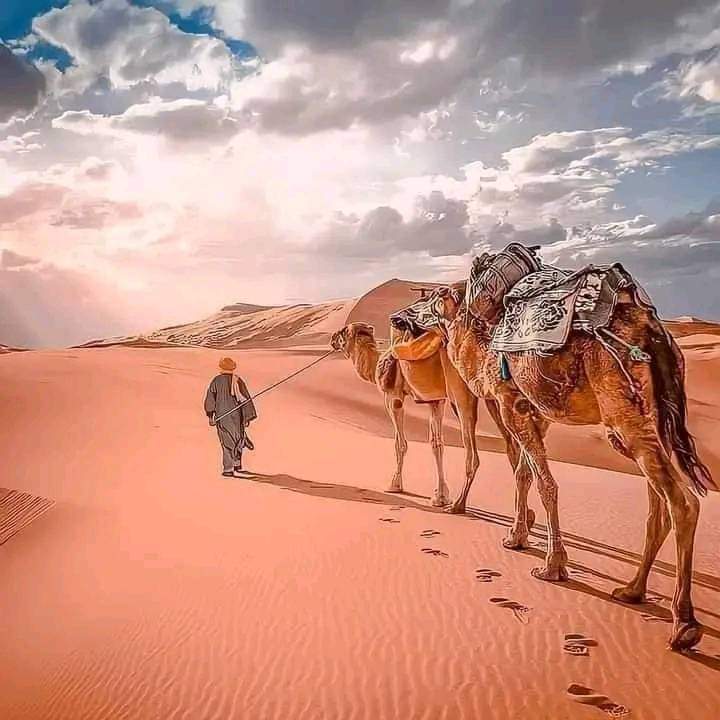
- Combine stargazing with a sunrise camel ride — see our camel trekking tips.